Flexible Benefits vs. Fixed Benefits: Which Model Works for Your Team?
Fixed benefit packages give everyone the same thing. Flexible models let employees choose. One of these leads to real usage. Here is the comparison.
For most of its history, the employee benefits model has worked like this: the company decides what benefits to offer, signs contracts with vendors, and every employee gets the same package.
The gym membership goes to the person who runs marathons and the person who has not been to a gym since 2018. The meal vouchers go to the remote employee and the person who works in the office next to three good restaurants. Everyone pays the same. Nobody asked.
The flexible benefits model flips this. Instead of the company choosing for everyone, employees choose for themselves — from a range of categories — using a benefit budget provided by the company.
What fixed benefits actually look like in practice
Fixed benefit packages are the default at most companies. The company negotiates deals with vendors: a corporate gym rate, a healthcare plan, a meal voucher scheme. Every employee gets access to the same set.
On paper, this looks generous. In practice:
- The gym partnership covers 2 locations and 70% of your team does not live near either of them.
- The meal vouchers only work in the office and 40% of your team is remote.
- The wellbeing app was used by 30% of employees in the first month and is now used by fewer than 10%.
This is not a failure of intent. It is a structural problem with the model. A single fixed package cannot fit 50 different people with 50 different lives, priorities, and locations.
The real cost of fixed benefits nobody uses
When employees do not use a benefit, two things happen simultaneously. The company keeps paying for it. The employee stops seeing the company as a place that understands what they need.
A company running a fixed benefit stack for 80 employees, spending £200 per employee per month, and achieving 40% average utilization is effectively spending £9,600 per month on benefits people are using — and £9,600 per month on benefits they are not. That second £9,600 is the cost of the fixed model.
What flexible benefits actually look like in practice
A flexible benefits system gives each employee a benefit budget and lets them choose how to spend it from a range of approved categories. The company sets the budget and the boundaries. The employee makes the choices.
What this looks like day-to-day:
- The marathon runner puts their budget toward gym and fitness.
- The remote employee puts theirs toward home office equipment and a learning subscription.
- The new parent allocates toward wellbeing and a meal delivery service.
- The employee who already has private healthcare puts their credits toward professional development.
Same company. Same monthly benefit budget per employee. Four completely different spending patterns. All of them high utilization because every person got something they actually wanted.
The two types of flexible benefits system
Reimbursement-based flexible benefits
Employees purchase benefits themselves and submit receipts for reimbursement. The company sets an approved list and a monthly cap. The intention is good. The execution creates friction — employees spend their own money first and wait to get it back. Utilization rates tend to be lower than expected because the process is too much work for small benefit amounts.
Credit-based flexible benefits
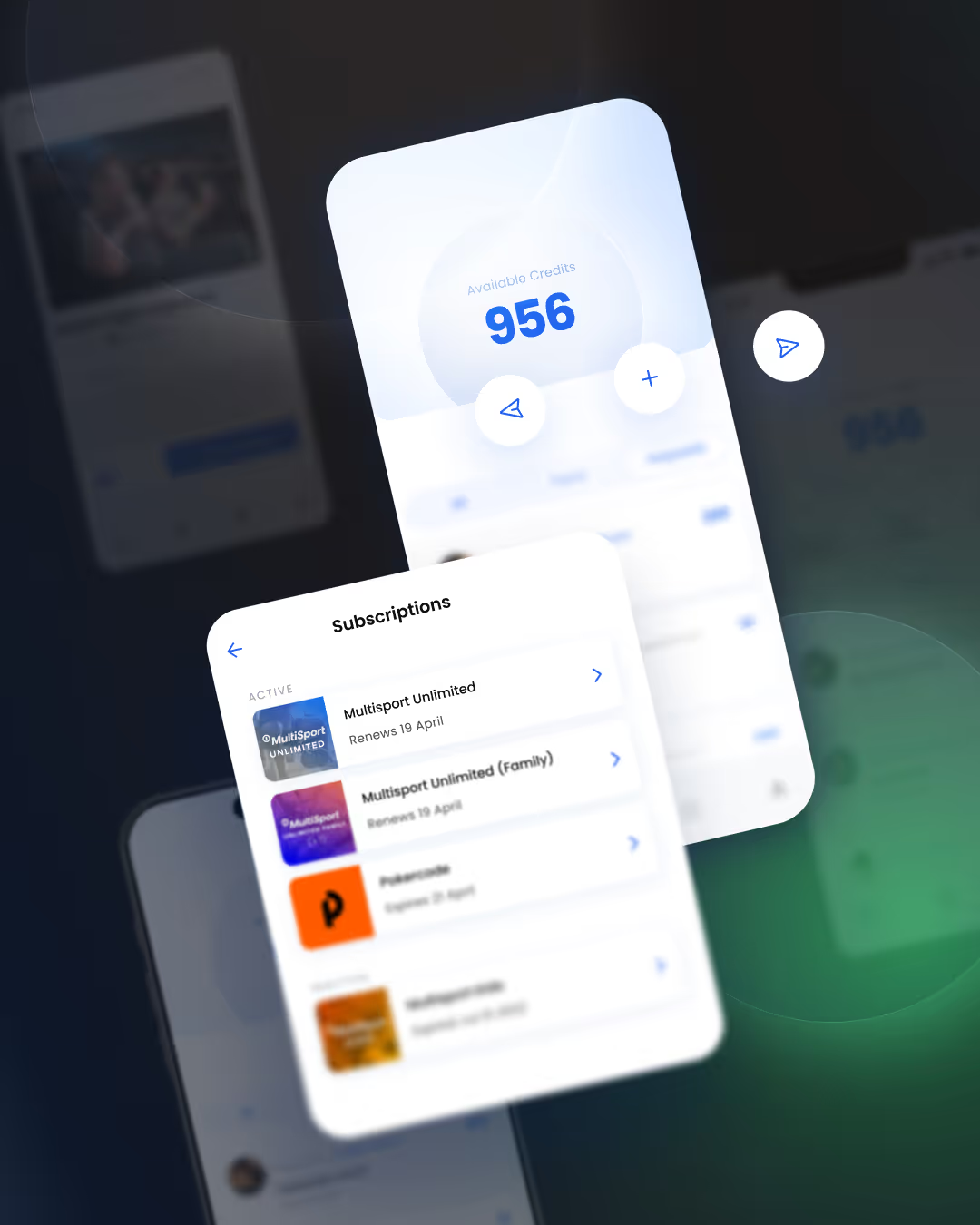
The company provides a credit balance — a digital budget employees can see — and employees spend it directly in a marketplace. No receipts. No reimbursement waiting period. No personal money involved.
The visible balance is the key mechanism. When employees can see ₵200 sitting in their Wallet, they spend it. When they have to initiate a reimbursement claim for the same amount, most of them do not bother. A credit-based flexible benefits platform removes the friction entirely.
Fixed vs. flexible — the direct comparison
When fixed benefits still make sense
Fixed benefits have a place. If you have a highly homogeneous team with similar needs and locations, a well-chosen fixed package can be efficient. Group healthcare plans often have pricing advantages that a flexible model cannot match at smaller company sizes.
The question is not whether fixed benefits are bad. It is whether they are the right primary model for your company’s current reality. For most companies with distributed, diverse teams — especially those with remote employees — a flexible credit-based model delivers higher engagement for the same or lower total spend.
The short version
Fixed benefits give everyone the same thing. Some people value it. Most people use some of it. A portion of the spend disappears into subscriptions nobody opens.
Flexible benefits give each employee a budget and let them choose. Usage goes up because the benefit matches the person, not the other way around. The credit model — where employees see a visible balance and spend it in a marketplace — is the flexible approach with the lowest friction and the highest engagement rate in practice.
Frequently asked questions
A flexible benefits system gives employees a benefit budget and lets them choose how to spend it from a range of approved categories, rather than receiving a fixed package. There are two main models: reimbursement-based (employees submit receipts) and credit-based (employees spend a visible balance directly in a marketplace). The credit model tends to have significantly higher utilization because it removes the need to spend personal money first.
Flexible benefits tend to produce higher utilization because employees choose categories that match their own priorities. Fixed packages often have low utilization in categories that do not suit a large portion of the team. For diverse or distributed teams, flexible benefits typically deliver better value from the same budget.
Salary sacrifice is a tax arrangement where employees give up part of their salary in exchange for benefits. Flexible benefits is a model where the company provides a benefit budget and employees choose how to spend it — no salary reduction is involved. They are different concepts and can be used independently.
The company purchases a bundle of credits and allocates a fixed amount to each employee. Employees see their credit balance in a personal Wallet and spend it in a marketplace of benefit categories. No reimbursement process, no personal money involved, no friction between the employee and the benefit.
See what a flexible, credit-based benefits platform looks like.
One credit system. Every benefit use case covered.
No subscription — buy credits and allocate them.