Employee Rewards Programs: What Works, What Doesn’t, and What to Measure
Most rewards programmes fail quietly. Points nobody redeems, rewards nobody wants, too much friction. What actually drives engagement and how to measure whether yours is working.
Most employee rewards programmes are not cancelled. They are just quietly forgotten. The launch gets attention. Engagement is good in month one. Then it fades. Six months later the programme exists in the HR handbook and nowhere else.
The companies that run rewards programmes well — where employees actually engage month after month — have avoided three failure patterns and measure what matters instead of what is easy to count.
What fails in most employee rewards programmes
Points that cannot be redeemed
The most common failure is a currency problem. Points accumulate. The redemption threshold is high. The catalogue requires so much navigation that most employees give up before completing a redemption.
The result: employees watch their points balance grow and derive almost no actual benefit. This is not a motivation problem. It is a design problem. A currency that is hard to spend is not a benefit — it is a delayed disappointment.
Rewards nobody wants
A programme that offers rewards employees do not value will have low engagement regardless of budget. The classic failure is a catalogue loaded with branded merchandise, obscure gift vouchers, and “experiences” that require additional effort to use. Meanwhile, employees would rather have a coffee voucher, a gym credit, or a contribution to a learning platform they already use.
Too much friction at every step
Sending recognition in most programmes requires: logging into a separate platform, finding the nomination form, completing required fields, submitting for approval, waiting for processing. By the time the cycle completes, the moment that prompted it is weeks old. High-friction systems produce low participation — not because employees do not care, but because discretionary behaviour has a low tolerance for process.
What actually drives engagement
A real, visible currency
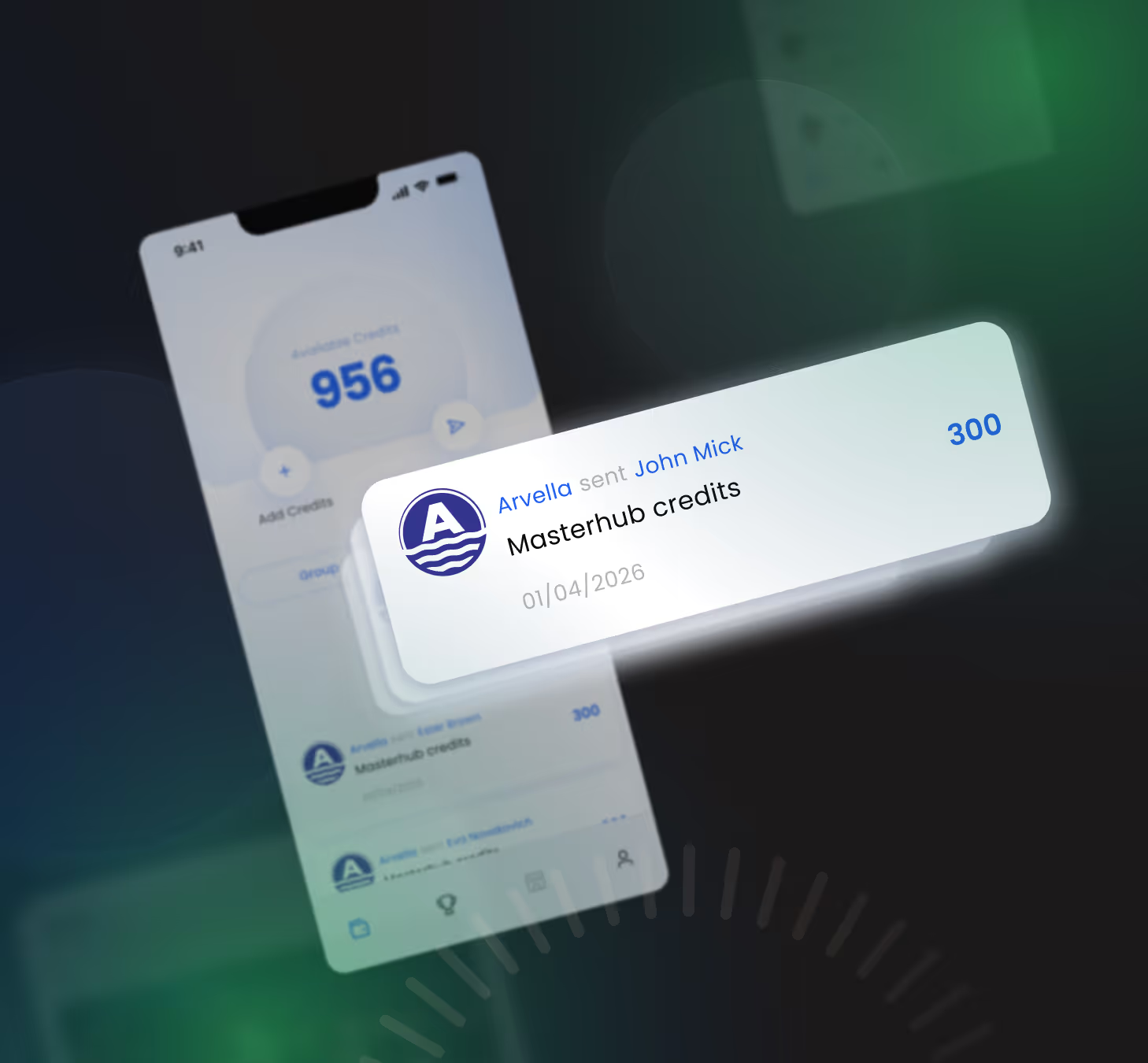
The single biggest lever for engagement is a visible balance employees can see without logging in anywhere new. A credit balance that employees see regularly — in the same platform where they access every other benefit — drives spending behaviour in a way that accumulated points do not. When the balance is visible, it stays in the employee’s awareness. The programme is present in their daily experience, not something they only encounter when HR sends a reminder.
Rewards tied to categories employees choose themselves
The highest-engagement rewards programmes give employees a real choice — a marketplace of categories where each person picks what fits their life. One employee uses credits for gym access. Another puts them toward a learning subscription. A third uses coffee vouchers. The company has provided the budget. Each employee has directed it toward something they genuinely wanted. Utilization is high because relevance is high.
Peer recognition baked in
Programmes that include peer-to-peer recognition — where employees can send credits to each other, not just receive from the company — consistently outperform top-down-only systems. When colleagues can acknowledge each other, recognition happens more frequently, more specifically, and more visibly. It becomes part of the daily rhythm of work rather than an event that happens a few times a year.
No approval required for peer sends
Peer recognition that requires manager approval is not peer recognition — it is a slower version of manager recognition. The speed and spontaneity are what give peer recognition its specific value. Remove those and you have added an administrative layer to a process that was supposed to be human and immediate.
What to measure — and what to ignore
A high spend number is not the same as high engagement. A programme that spends its full budget on things nobody uses is not working. 500 automated milestone awards carry less weight than 200 spontaneous peer recognitions with personal messages.
The short version
Employee rewards programmes fail because the currency is hard to spend, the rewards are not what employees want, and the process is too slow. They succeed when the balance is visible, the marketplace is relevant, peer recognition is built in without an approval gate, and the admin can see real utilization data.
The measurement that matters is whether employees are actually using the programme — not whether it looks good in an HR strategy deck.
Frequently asked questions
Three things above all: a visible, real currency (not just points that are hard to redeem), rewards tied to categories employees actually want, and peer-to-peer recognition without an approval process. Programmes that score high on all three consistently outperform those that rely on periodic company-to-employee awards with a restricted catalogue.
The primary metric is credit or reward utilization rate — what percentage of the allocated reward budget is actually being spent. Secondary metrics include peer recognition frequency, category distribution, and employees with zero activity. Award volume and total programme spend are less useful than utilization.
The three most common failure modes are: a reward currency that is difficult to redeem (high points threshold, poor catalogue), rewards that employees do not actually want, and too much friction in the sending process (approval workflows, separate platform logins, processing delays).
A recognition and rewards platform is software that manages how a company acknowledges and rewards employee contributions. The best platforms combine company-to-employee credit allocation, a marketplace where employees spend their reward balance, and peer-to-peer recognition that employees can send without manager approval. Utilization analytics are included so admins can see whether the programme is reaching people.
A rewards programme people actually use.
Visible balance. Real marketplace. Peer recognition without the approval queue.
No subscription — buy credits and allocate them.